
A backup asks “do I have another copy?” An integrity check asks “does this project still make sense internally?”
Long projects contain relationships, not only text
A B-Maker project includes sections, versions, current-version pointers, planning links and other internal relationships. The text can look present while one of those relationships is inconsistent.
Integrity matters before risky operations
Before a major restructure, migration, restore or final export, a check gives you another signal that the project is in a coherent state before you create new copies or deliverables.
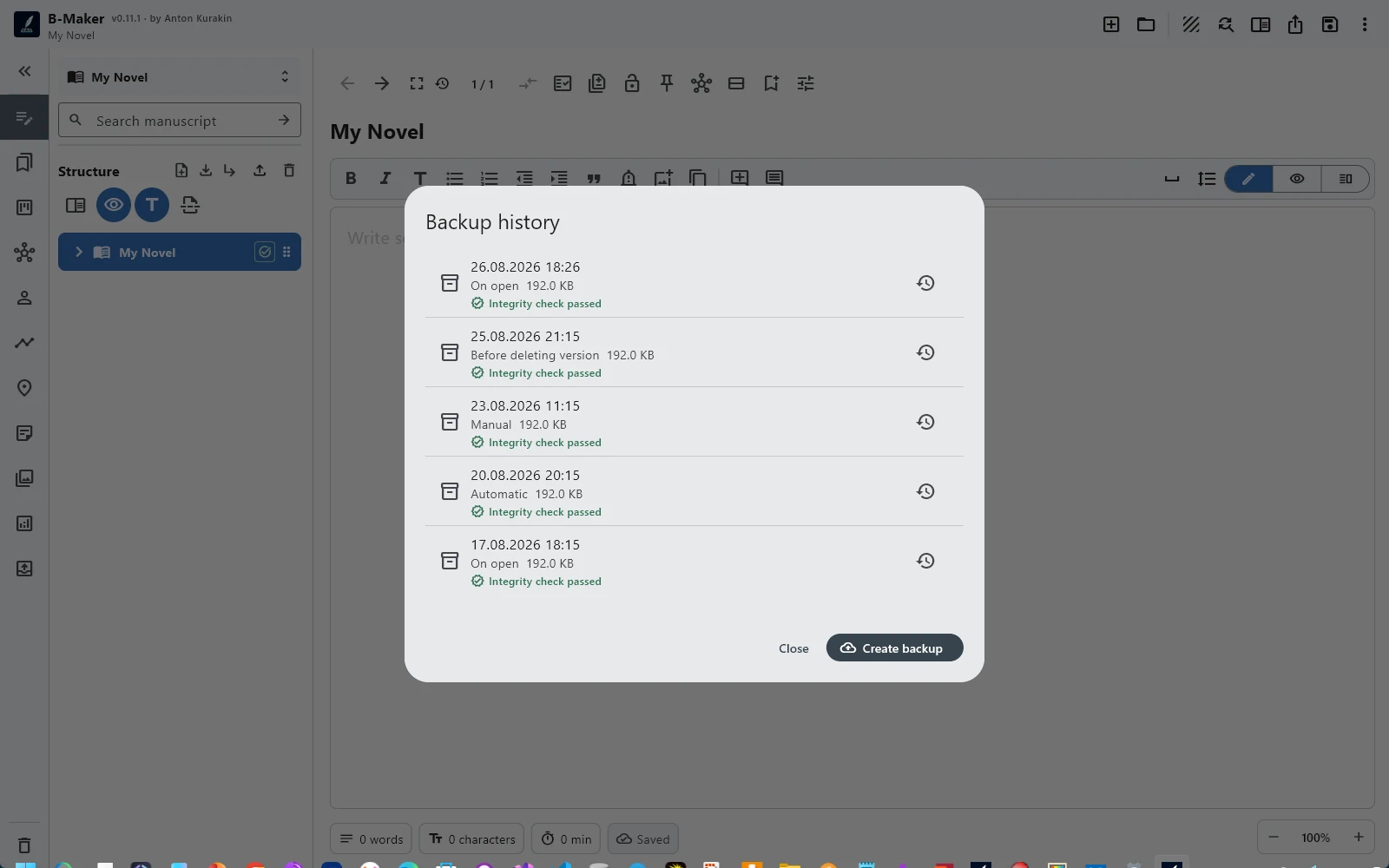
It does not replace backups
An integrity check cannot recover a deleted disk or stolen laptop. A backup cannot tell you whether the copy you made contains a logical inconsistency. Good project safety uses both.
Do not turn validation into ritual
You do not need to run it after every sentence. Use it around meaningful risk: before export, after restore, after unusual project operations or whenever something appears inconsistent.
Version vs backup · Why local-first? · See the local-first workflow