
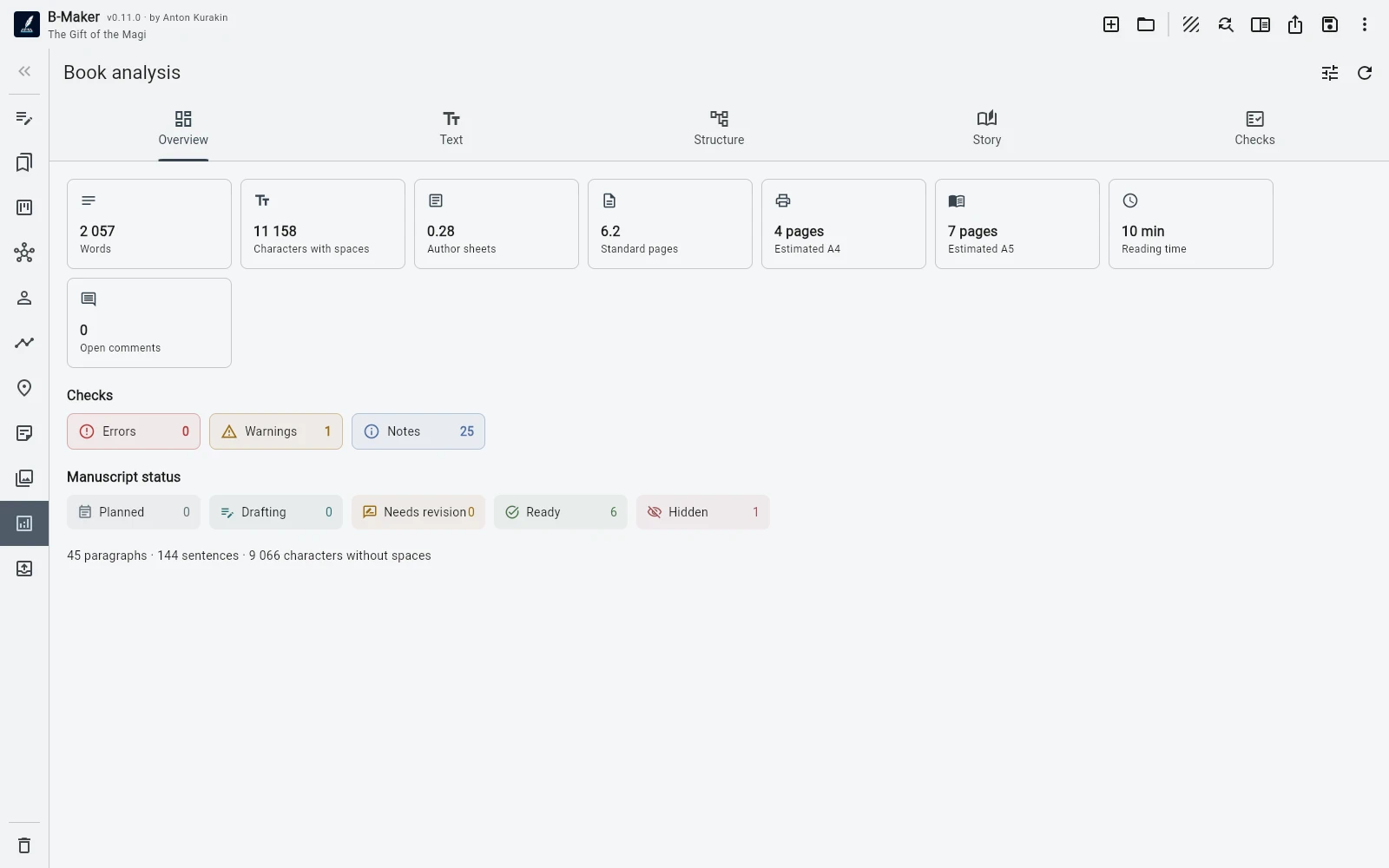
B-Maker does not try to decide whether your prose is good. It looks for mechanical signals worth reviewing: repetition, long sentences, filler words, structural gaps, unfinished markers and project inconsistencies.
The last read is the hardest read
After months inside a manuscript, the author knows it too well. Missing transitions are mentally supplied. Repeated words become invisible. A forgotten “TODO” can sit in a chapter because your brain reads the finished sentence you intended to write.
This is exactly where software is useful: not as a literary judge, but as an tireless second pass over details that can be counted, compared or flagged.
Start with measurements, not verdicts
Word count, character count, reading time, dialogue share, estimated pages and author sheets are descriptive. They do not say whether the book is good. They simply make the shape of the manuscript visible.
The same principle should apply to editorial checks. “This sentence is long” is a useful signal. “Long sentences are bad” is not. A deliberate 45-word sentence can be excellent; ten accidental ones in a row may deserve attention.
assets/img/bmaker/bmaker-story-edit-01.webpSome problems are textual
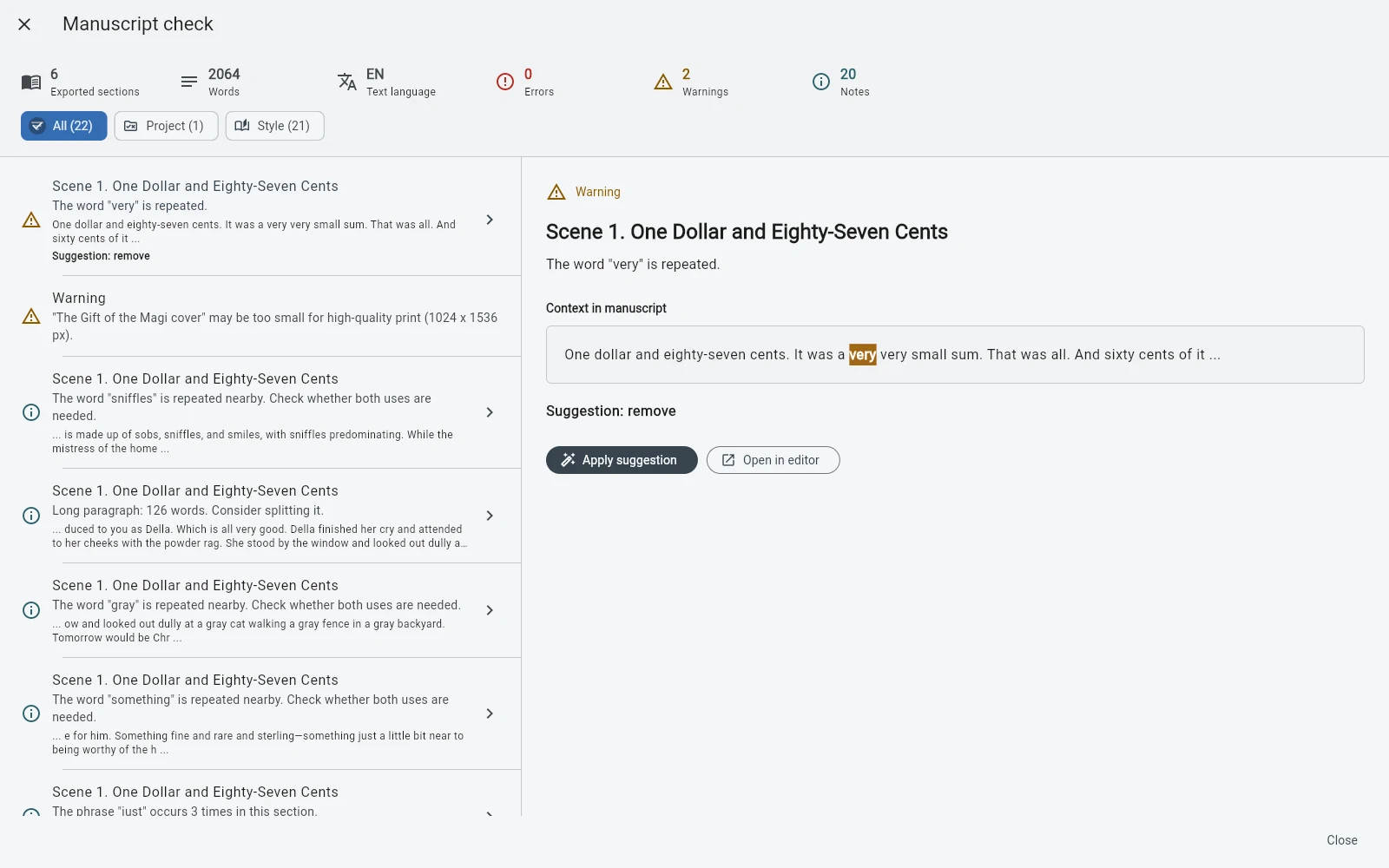
B-Maker can surface repeated wording, long sentences and filler-word patterns in Russian and English. These checks are meant to create a review queue. The author decides whether each finding is a problem, a stylistic choice or irrelevant.
This is important because aggressive automatic correction often flattens voice. A useful tool points; it does not silently rewrite the manuscript into its preferred style.
Other problems exist at the project level
A book can also be mechanically incomplete. An empty section. A chapter without a current version. A draft marker left behind. A planning card that never became text. A scene that is no longer linked where you expected it to be.
Those issues are difficult for a normal spell checker because they are not grammar problems. They require knowledge of the project structure.
The best check is one you can inspect
A warning is useful only if you can get from the warning to the relevant text or project element quickly. The practical loop should be: see the issue, open the place, decide, fix or ignore, move on.
Checks should support editing, not replace it
The final manuscript still needs human judgment. Structure, rhythm, argument, emotional truth, factual accuracy and voice cannot be reduced to a checklist of lexical statistics.
But every minute not spent hunting for a forgotten marker or accidental repetition can be spent on those harder editorial decisions. That is the role B-Maker gives automation.
Related stories
No more final-final.docx · From manuscript to publishing package · Start writing first
Let software find the boring mistakes.
Keep the judgment for the author and editor.