
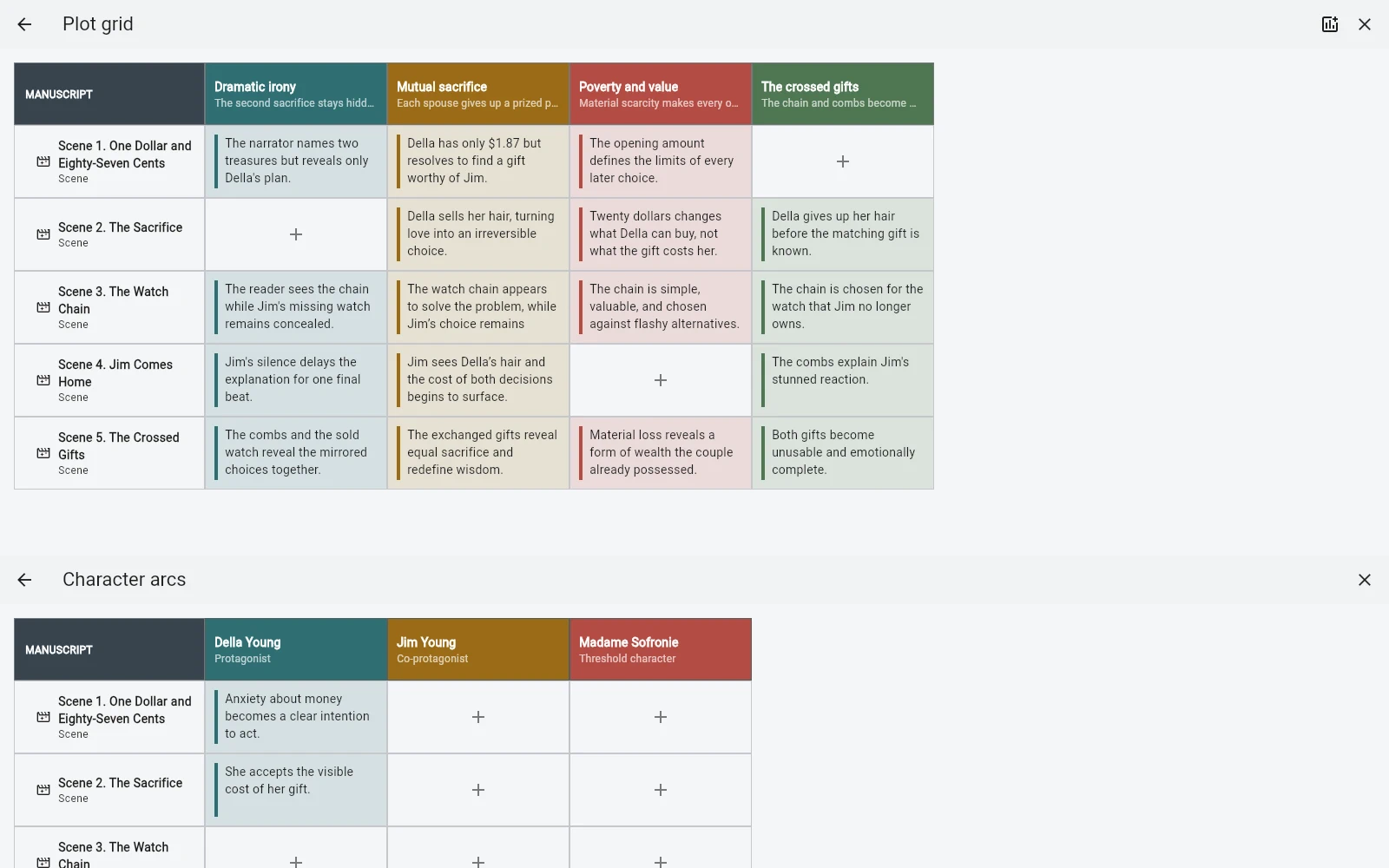
Where does this plotline disappear, where does this character stop changing, and which chapter is carrying too many threads at once?
A chapter view is longitudinal
You read Chapter 1, then 2, then 3. That is exactly how the reader experiences the book, but it can hide patterns that stretch across many chapters.
Story Grid cuts across the manuscript
Put plotlines or story dimensions against scenes and chapters. Suddenly long gaps, overloaded areas, missing payoffs, and weak character progression become visible as patterns rather than vague impressions.
It is useful after drafting too
Story Grid is not only an outlining tool. In revision it can be more valuable: the manuscript already exists, so the grid becomes a diagnostic instrument for checking distribution and continuity.
When not to use it
If the story is simple enough to hold in your head, skip it. The grid earns its cost only when parallel story movement becomes hard to inspect by ordinary reading.