
A character sheet, plot spreadsheet and manuscript often begin consistent. Then the text changes, and three different representations of the same story slowly disagree.
Story planning usually starts outside the manuscript
A spreadsheet is an excellent general-purpose tool. So is a whiteboard. So is a notes app. The difficulty begins when they stop being temporary thinking aids and become permanent databases that duplicate facts already present in the book.
A scene moves. A character is removed. A plotline appears earlier. Now the manuscript says one thing, the spreadsheet another, and the visual board still shows last week's version.
Characters should know where they appear
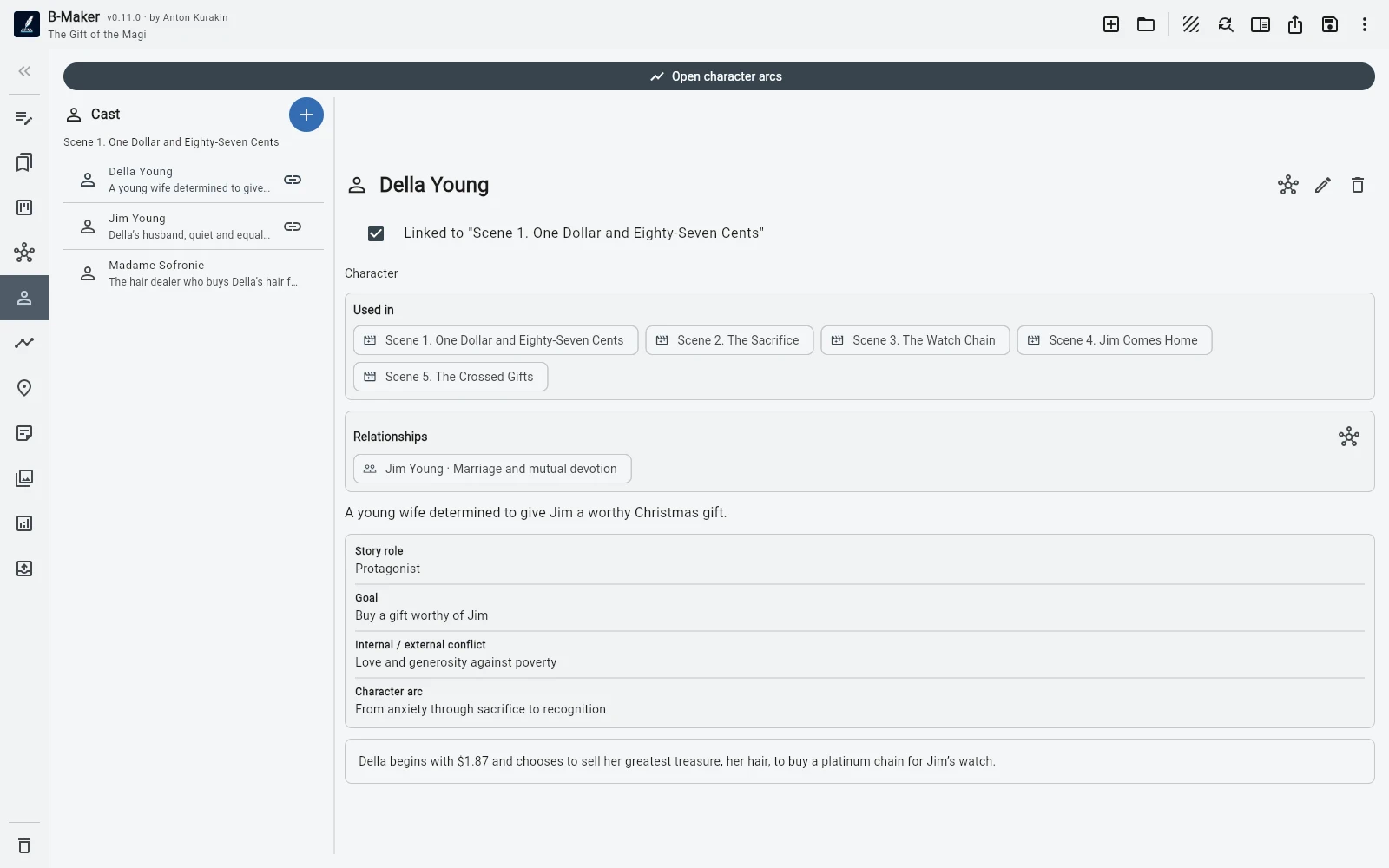
In B-Maker a character can have structured properties and relationships while remaining connected to manuscript elements. The useful question is not only “what color are her eyes?” but “where does this character enter the story, which scenes involve her, and how does the arc change across them?”
That turns character planning from a static biography into a view over the actual project.
assets/img/bmaker/bmaker-story-plot-01.webpPlotlines should cross the manuscript, not live beside it
Plotlines are useful because a novel is rarely only one sequence. The main conflict, a relationship arc, a mystery thread and a secondary character may all move through different chapters at different speeds.
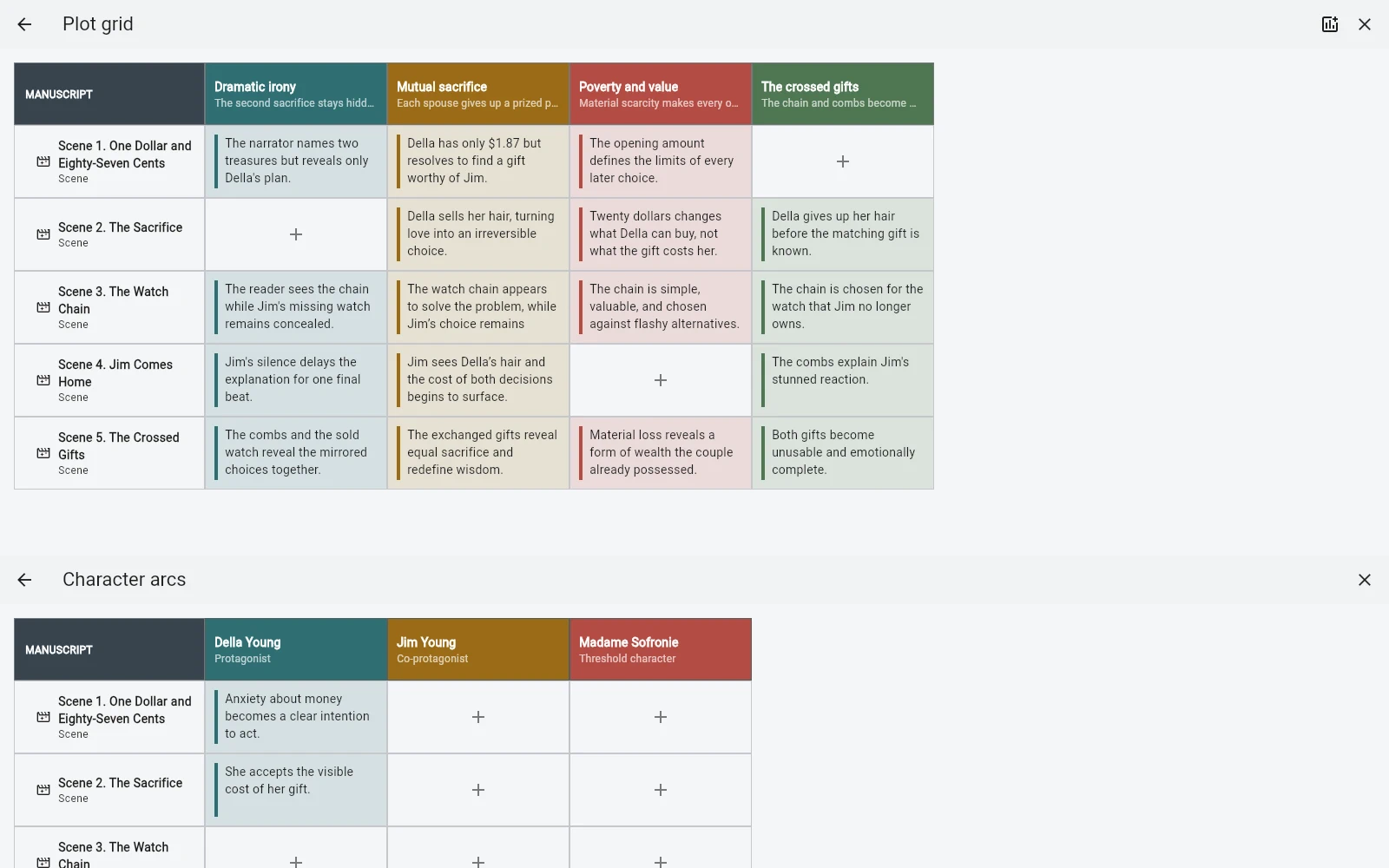
B-Maker can connect those plotlines to manuscript elements and show them in the story grid. Instead of asking “did I update the spreadsheet after moving this scene?”, you can ask the more useful question: “where does this plotline disappear for too long?”
Arc points make change visible
A character is not only a set of attributes. The interesting part is movement. Arc points tied to scenes let you record the important changes along that path: a decision, a loss, a reversal, a new belief, a broken relationship.
This is especially useful during revision, because you can inspect whether the emotional and narrative changes are distributed across the actual manuscript rather than across an abstract outline.
Use planning when the story becomes hard to hold in your head
None of this needs to exist before the first page. A short story may never need a story grid. A simple novel may need only a few character cards. The deeper model becomes useful when the manuscript develops enough moving parts that memory is no longer reliable.
The principle is the same as elsewhere in B-Maker: do not create planning bureaucracy in advance. But when complexity arrives, connect the planning model to the text instead of maintaining a parallel universe beside it.
Related stories
One manuscript, several views · From idea to chapter · Start writing first
Let the planning model follow the manuscript.
Track the story where the story actually lives.