
Keep book and chapter goals close to the manuscript, then use daily activity and writing-session history to understand progress without maintaining a separate tracker.
A target is only one part of progress
“Write 80,000 words” is clear, but it does not tell you what happened this week. A large project advances through smaller units: a chapter completed, a difficult section rewritten, several days of steady work, then perhaps a pause.
When progress lives in a separate spreadsheet or habit tracker, the author has to maintain another system beside the book. B-Maker keeps the basic progress signals inside the writing project.
Use a book goal for direction
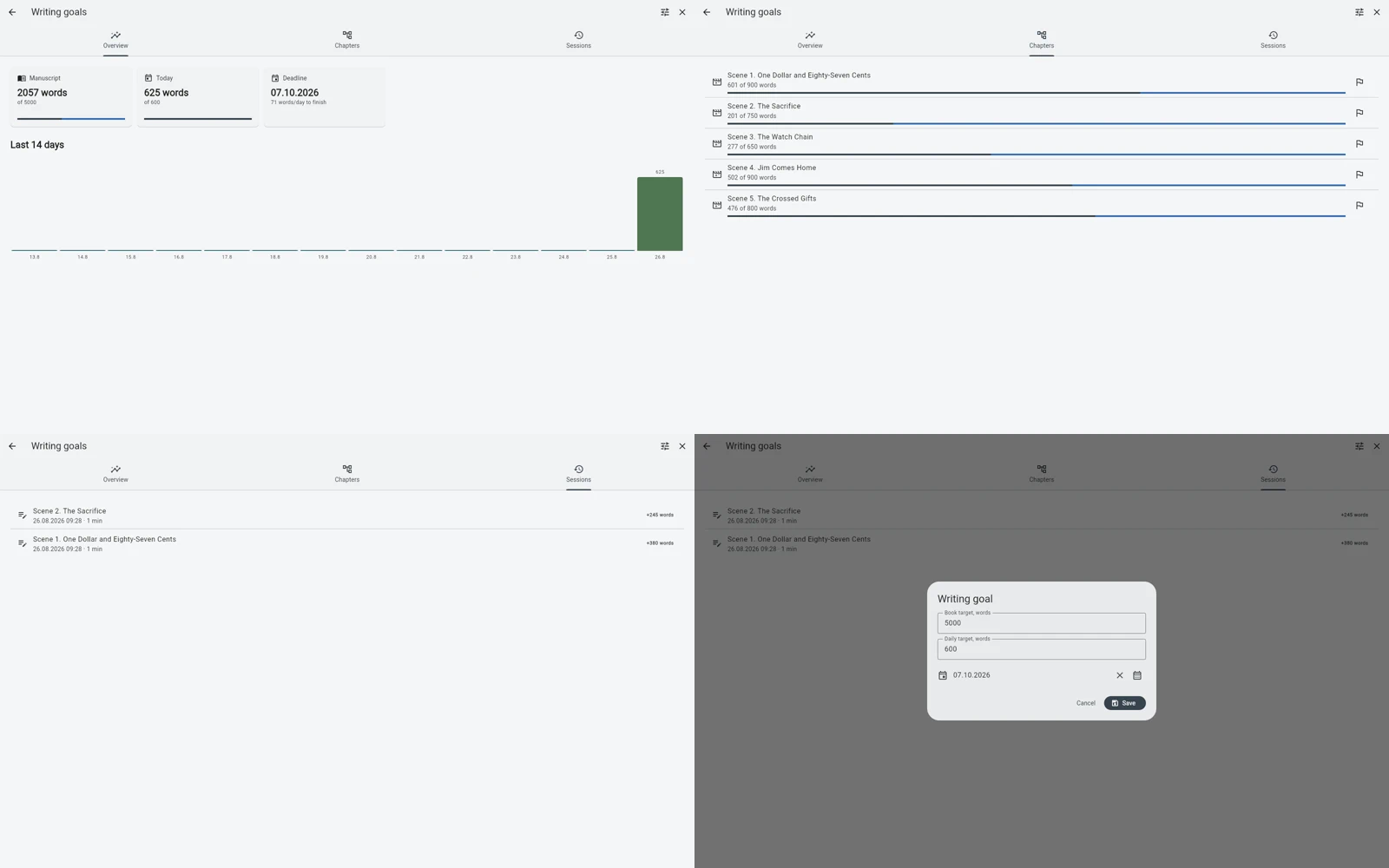
A book-level goal gives the project a rough destination. It is not a promise that the final manuscript must hit an exact number. It is a planning signal: are you still at the beginning, somewhere in the middle, or approaching the scale you expected?
The number matters less than the relationship between the target and the manuscript that actually exists.
Use chapter goals when the project becomes uneven
Long manuscripts are rarely balanced. One chapter may need 8,000 words; another may work better at 1,500. Chapter goals let the local part of the book have its own expectation instead of pretending every section should look the same.
This is especially useful during revision, when the question is often not “How long is the book?” but “Why is this part still underdeveloped?”
Daily activity answers a different question
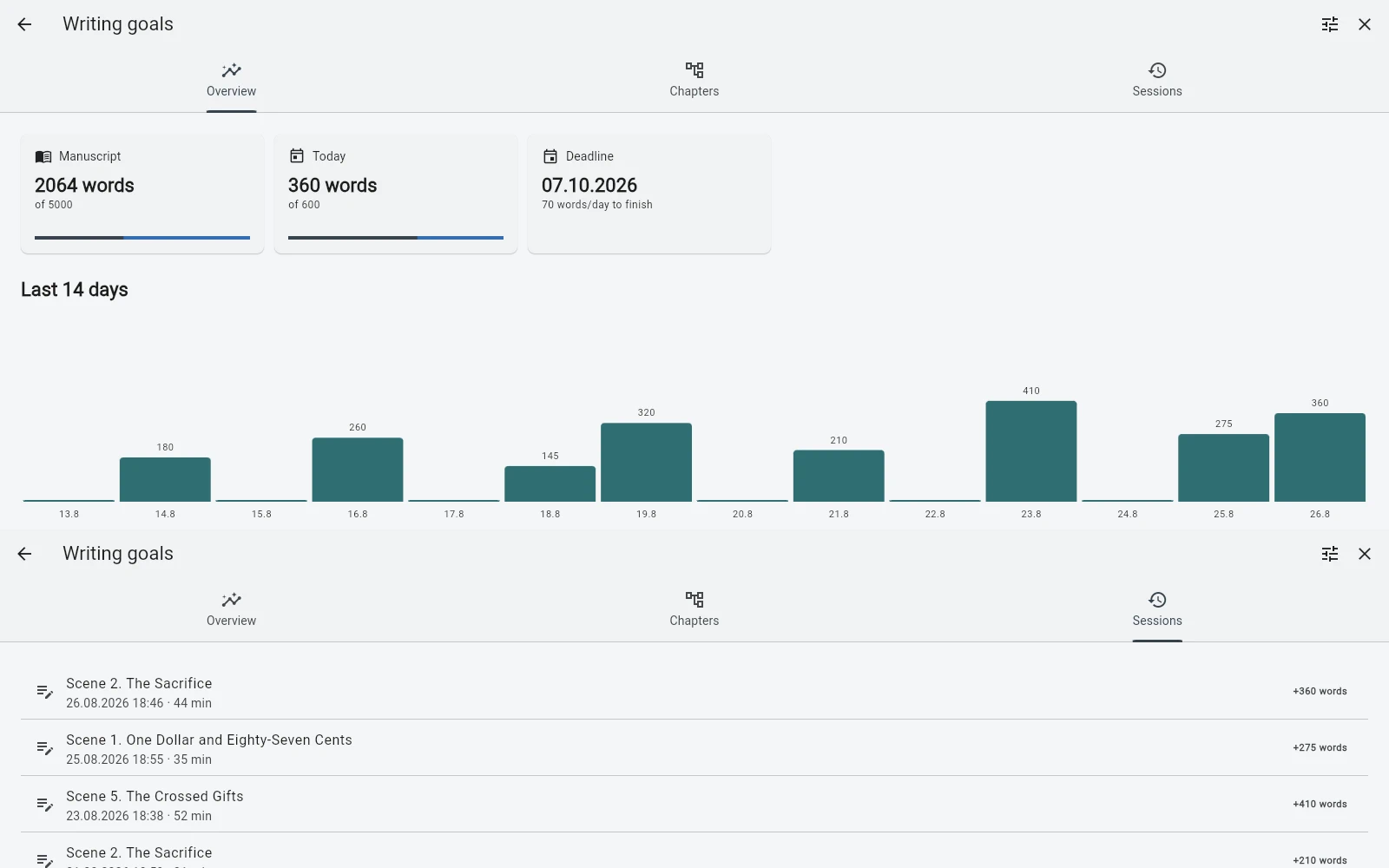
A goal describes where you want to go. Daily activity shows whether work is happening. The distinction matters because writing is not always linear. Some days add words; other days replace them.
Seeing activity over time is useful as context, not as a score. A slow week may be a problem, or it may be the week you solved the chapter that was blocking everything else.
Writing sessions give the history some shape
Session history helps connect progress to actual periods of work. Instead of remembering vaguely that you “worked on the book a lot,” you can see that the project has accumulated through many concrete writing sessions.
The point is not to turn an author into a time-tracking employee. It is to make the process visible enough that you can notice your own rhythm.
Do not let measurement become the work
Metrics are useful only while they remain cheaper than the problem they solve. You should not need to prepare a dashboard before writing. Goals and sessions belong later in the workflow, when a project has grown enough that progress itself becomes difficult to feel.
That is the same progressive-complexity rule used elsewhere in B-Maker: start with text. Add measurement when measurement becomes useful.
Related stories
Start writing first · Write in chapters. Read the whole manuscript. · What should writing software check before you publish?
Make progress visible without making it the product.
Write first. Use goals and session history when the project becomes large enough that you want a clearer signal of movement.