
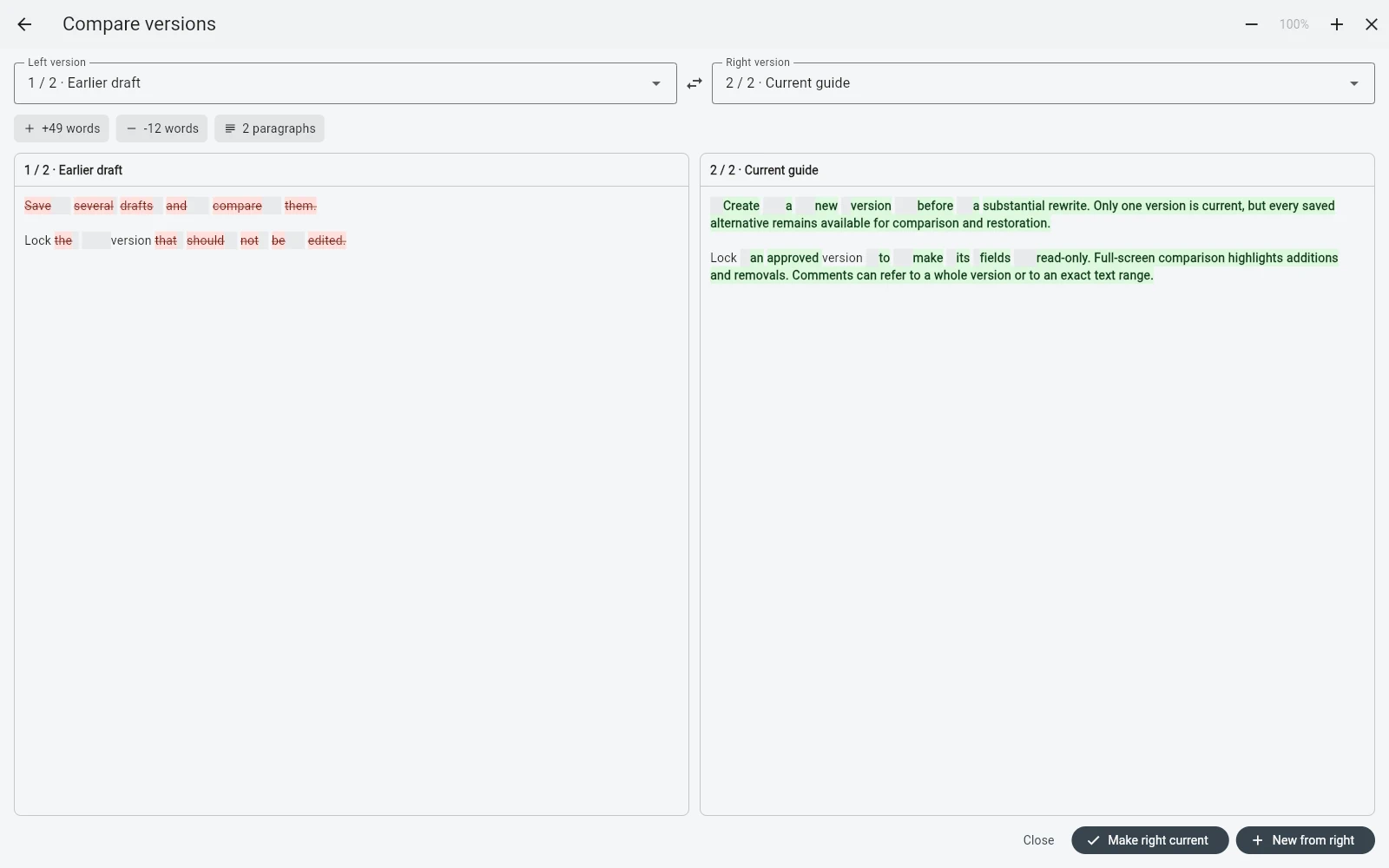
Original → new version → AI experiment → comparison → author decision.
Direct replacement hides the cost of the experiment
An AI rewrite can sound smoother while deleting context, examples, ambiguity, rhythm, or voice. If the result immediately overwrites the working text, the comparison becomes dependent on memory.
A version makes the experiment explicit
Name it “AI shorter pass,” “Alternative opening,” or whatever describes the hypothesis. Now the experiment has a boundary and the original remains a stable reference.
Compare outcomes, not impressions
Which examples disappeared? Did the passage actually become shorter? Did the new wording add generic language? Did the model solve the problem you asked about while creating another one?
assets/img/bmaker/bmaker-explained-ai-version-01.webpYou are not required to choose one whole version
The experiment may contain one useful sentence and ten worse ones. Versioning lets AI produce material without turning acceptance into an all-or-nothing decision.
This is the deeper reason for integration
The interesting feature is not “there is AI.” It is that AI can participate in an editorial workflow where state, comparison, and authorship remain visible.